Historical Context: This is a summary of the 2012 Field Study by Romola V. Thumbadoo entitled: An examination of the presence of the Indigenous voice in the evolution of environmental ethics over the past sixty years
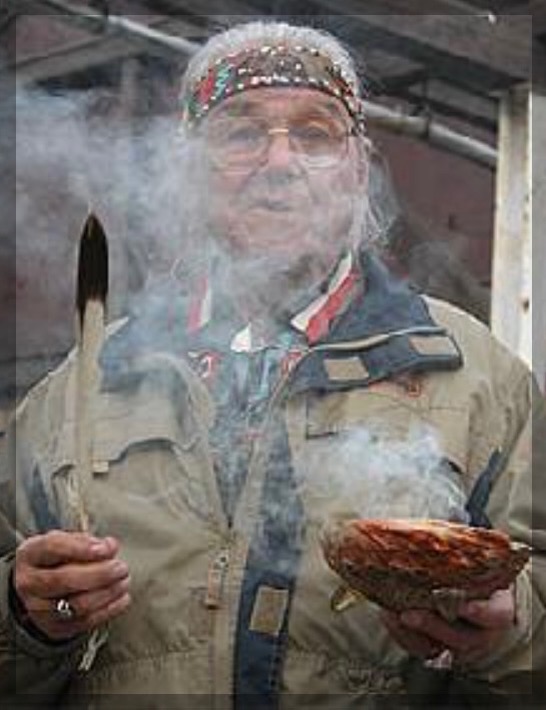
William Commanda, Keeper of the Sacred Wampum Belts of the Algonquins of the Ottawa River Watershed, offered the opening prayer and address at the United Nations Cry of the Earth Conference in 1993, where the Gaia Atlas of First Peoples, by Julian Burger with campaigning groups and native peoples worldwide (1990) was presented; it draws into the public limelight such factors as the detailed, sophisticated and unique character of Indigenous knowledge, much of it still unknown to scientists, botanists and entomologists: of soils, rocks, climate, plants and animal-life; of medicinal plants and healing processes; and of the relevance of stars, wind, waves, moon, earth cycles, birds and fish to travel, navigation and fishing. The current public interest in the Mayan calendar is an indication of the growing recognition of the relevance of the multi-layered dynamics inherent to temporal and spatial knowledge geographical knowledge.
When William Commanda offered the opening address, the concerns he had been raising for decades regarding the relationship between people, land, and Mother Earth were gaining broader international attention. Around the same period, The Gaia Atlas of First Peoples helped bring Indigenous knowledge, environmental stewardship, and traditional ecological perspectives into global environmental discussions.
This 2012 Geography Field Seminar paper examines the growing presence of Indigenous perspectives in environmental ethics over the previous sixty years. It traces the evolution of environmental thinking from early philosophical calls for a “land ethic” through Deep Ecology, ecological intelligence, and emerging environmental justice movements, while asking an important question:
To what extent has the Indigenous voice been present, acknowledged, or integrated in the search for an environmental ethic?
The paper identifies three broad phases:
- An early period in which Indigenous perspectives were present largely in the background, occasionally referenced but seldom centred.
- A period of increasing scholarly examination of Indigenous environmental knowledge and ethics.
- The growing emergence of Indigenous voices speaking directly and authoritatively within environmental, geographical, and ecological discussions.
A key conclusion of the paper is that Indigenous perspectives contributed far more to the evolution of environmental ethics than is often acknowledged. Long before climate change became a dominant global concern, Indigenous peoples were advancing concepts of relationship, reciprocity, responsibility, respect for Mother Earth, interdependence, and stewardship that are increasingly relevant in contemporary environmental debates.
Looking back today, the paper can also be read as an early exploration of themes that continue through later Circle of All Nations, Children’s Mapping, and Human-AI work: relationship, voice, participation, knowledge systems, ecological responsibility, and the question of how new perspectives enter and transform established discourse.