
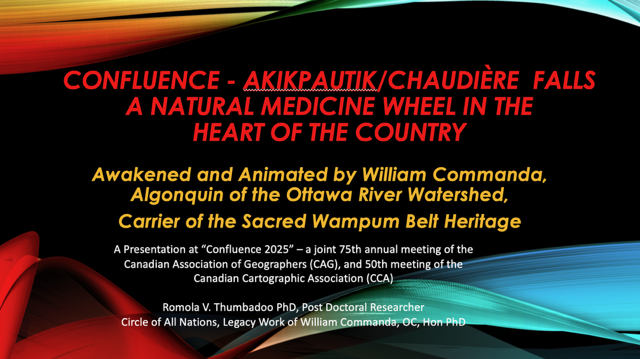
AKIKPAUTIK: From Conflictual views to Confluence:
As I came close to the end of my phase in academia, I was presented with a remarkable opportunity to reflect on the William Commanda/Circle of All Nations knowledge, wisdom, epistemology and discourse that I had been studying at Carleton University since 2012.
From the onset, my PhD (and later postdoctoral) research, begun innocently enough, was disrupted by challenges to Elder Commanda’s vision for the Asinabka International Healing and Peace Building Centre at the Sacred Chaudiere Falls. This impacted the visibility of the William Commanda contribution to the tremendous shift in the visibility of Indigenous Peoples and Indigenous issues of the past years in Canada. Few will really be able deny that his near century of innovative activist, environmental and peace building work, augmented by our joint non-stop work during the last fifteen years of his life, contributed at every level to this transition in public consciousness and Indigenous presence. Despite being rendered largely invisible, his work and legacy will none the less not be stifled, and Circle of All Nations colleagues and others fan the many fires he ignited.
This phenomenon also manifested at Carleton University. In May 2025, exactly 25 years after the Circle of All Nations International Millennium Peace Gathering that Grandfather Commanda hosted at Nepean Point (Nepean, being as he said “the place where we sleep”, in the heart of the ancient palaeolithic site that Ottawa sits on), the Canadian Cartographic Association (CCA) hosted its 50th annual conference and general meeting, CCA2025, May 21-22, jointly with the 75th Annual Meeting of the Canadian Association of Geographers (CAG), from May 20th to 23rd, 2025 at Carleton University in Ottawa, and announced that CCA / CAG 2025 follows the theme “Confluence.” It noted that in Ottawa, the capital city of Canada, where this conference would take place, three majestic rivers converge. The confluence of the Ottawa, Rideau, and Gatineau rivers is more than just a geographical phenomenon. It represents a convergence of forces that shape our understanding of space, place, and identity. This natural wonder has significant spiritual meaning for Indigenous peoples. One of Ottawa’s most stunning natural landmarks, The Akikpautik / Chaudière Falls on the Ottawa River is a site of cultural importance, serving as a sacred meeting place for generations.
I was rather taken aback at first; while it has been really challenging to gain any visibility or support for our William Commanda research within the National Capital Region, it was significant that the word and place I had brought to light and visibility, Akikpautik / Chaudière Falls, that drew the geographers from across Canada together! What an irony.
I decided to submit an abstract on the William Command geonarrative of the sacred site, and amazing river that holds evidence of four periods of rock creation in Earth history, the laws of nature and his discursive reach. After all, we had been awakening folk to the incredible Ottawa River Watershed since 1997, and we had brought the sacred heart of the Chaudiere Rapids into public consciousness over multiple decades. The presentation allowed me to reassert and reaffirm the William Commanda/Circle of All Nations legacy in the academic world. And it was not only me who realized this. Dr Kwaku Kusi-Appiah, now a professor of Geography at Carleton University, had been working with former Mayor Bob Chiarelli at the time Grandfather Commanda was animating the vision for the Asinabka Centre. He stated that my presentation made his day; I guess it honoured the efforts of so many to advance the “nobel” vision for peace and healing. I include the photos of many individuals in my powerpoint presentation. It is a small way to memorialize their passionate engagement in the “hope” for a new world inspired by Grandfather.
This is our abstract:
Confluence references the meeting of three rivers in the heart of Canada’s capital and Akikpautik/Chaudiere Falls as a natural wonder and sacred meeting place of Indigenous Peoples. My thesis entitled Ginawaydaganuc and the Circle of All Nations, The Remarkable Environmental Legacy of Elder William Commanda references Champlain’s first 1613 sighting of the area: The water whirls about to such an extent, and in the middle boils so vigorously, that the Indians call it Asticou – a kettle (Champlain in Kennedy 1970 7). William Commanda stated that the Algonquin word for the sacred site was Akikpautik, and it was his tireless work there that brought an obscured brownfield into public consciousness around the turn of the century, with his vision for peacebuilding and environmental stewardship consistent with the laws of nature. This presentation examines his discursive reach 13 years after his death, and its relevance to the objectives of this conference to support geographers and cartographers foster new connections, collaborations, and insights; to illuminate complex issues; to examine the confluence of cultural, historical, philosophical, and economic understanding; and to demonstrate how maps shape and are shaped by our understandings of place, identity, and power. The singular geological and historical features of the Kichisippi/Ottawa River Watershed will also be highlighted.